
A technical guide for homeowners, architects and retrofit professionals.
Why suspended concrete floors matter
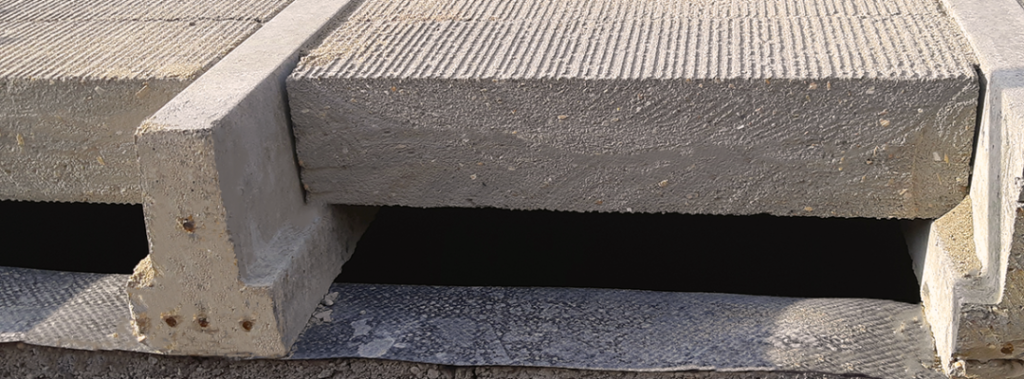
Suspended concrete floors most commonly block-and-beam constructions are widespread across UK housing stock from the mid-20th century onwards. While often assumed to perform better than suspended timber floors, uninsulated suspended concrete floors remain a major source of heat loss, discomfort, and uncontrolled air movement.
Common issues include:
- Heat loss through the exposed concrete soffit
- Cold radiant floor surfaces reducing thermal comfort
- Draughts and air leakage at floor-wall junctions
- Reduced effectiveness of other retrofit measures, including heat pumps
As with all raised floors, the underside of a suspended concrete floor sits outside the thermal envelope unless it is explicitly insulated and airtight.
Why traditional retrofit methods struggle
Retrofitting insulation to suspended concrete floors using conventional approaches is often impractical:
- Internal insulation from above is highly disruptive
- Cutting access hatches from above is structurally risky
- Fixing rigid boards below block-and-beam floors is slow, labour-intensive, and difficult to seal
- Airtightness at beam junctions and perimeters is rarely achieved in practice
As a result, suspended concrete floors are frequently left untreated, even where walls and roofs have been upgraded.
How robotic underfloor insulation works on suspended concrete floors
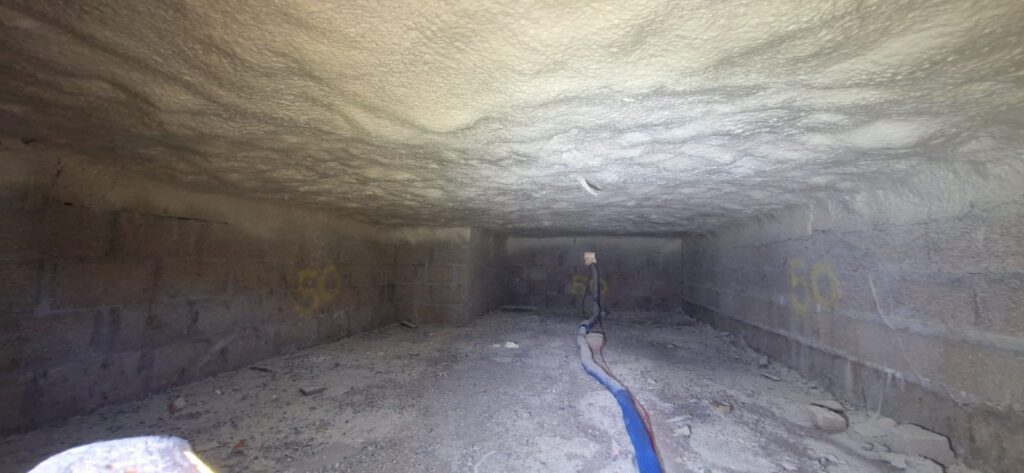
Q-Bot installs robotically applied, closed-cell spray foam insulation directly to the underside of the concrete floor from within the subfloor void.
The system:
- Applies insulation directly to the concrete soffit
- Forms a continuous, seamless insulation and airtightness layer
- Requires no internal disruption
Installation quality, coverage, and evidence are digitally captured as part of the QA process on Q-Bot’s industry leading Install Management System.
Access strategy: a key difference from suspended timber floors
Unlike suspended timber floors, access from above is rarely possible with suspended concrete construction unless an access hatch is already in situ.
Why top access is avoided
- Block-and-beam floors rely on continuity for structural integrity
- Cutting blocks or beams can weaken the floor
- Repairs are complex and often non-compliant
How access is achieved
Access is typically formed:
- Through external perimeter walls
- Using one or two access points, depending on layout
- Taking advantage of long, uninterrupted subfloor voids
In many cases, suspended concrete floors are easier to traverse robotically than timber floors, which are frequently divided by sleeper walls.
Insulation thickness, yield and certified thermal performance
Declared thermal conductivity (λᴰ)
The insulation used is a KIWA BDA Agrément–certified, HFO-blown, closed-cell polyurethane system, independently assessed in accordance with BS EN standards.
Declared aged thermal conductivity values:
| Installed thickness | Declared λᴰ |
|---|---|
| < 80 mm | 0.027 W/mK |
| 80–120 mm | 0.026 W/mK |
| > 120 mm | 0.025 W/mK |
These values are used for U-value calculations in accordance with BS EN ISO 6946, ISO 10211, and BRE conventions.
Application behaviour and yield
Suspended concrete floors differ fundamentally from suspended timber floors:
- There are no joists interrupting the insulation layer
- The insulation forms a fully continuous layer
- Thermal bridging is significantly reduced
As a result:
- Equivalent thermal performance to a typical suspended timber floor (often requiring ~120 mm)
- Can be achieved on suspended concrete floors with ~80 mm of insulation
Performance is delivered through continuity and airtightness, not thickness alone.
On concrete substrates:
- The first spray pass acts as a sacrificial flash coat to ensure adhesion
- This slightly reduces material yield
- Overall foam usage may be higher despite reduced final thickness
This behaviour is accounted for during design and installation and does not reduce thermal or airtightness performance.
Airtightness and moisture performance
The insulation forms a solid, seamless, closed-cell layer that contributes to airtightness and moisture control.
Independently assessed characteristics include:
- ~90% closed-cell content
- High water vapour resistance
- Low water absorption
- Watertight performance under test conditions
When designed in accordance with BS 5250 and BRE 262, the system can limit the risk of interstitial and surface condensation, while maintaining appropriate underfloor ventilation.
Radon gas barrier performance
Radon is a naturally occurring radioactive gas that can enter buildings from the ground. Suspended concrete floors are particularly relevant, as large subfloor voids can act as pathways for soil gases if not adequately sealed.
The closed-cell spray foam used in the Q-Bot system has been independently tested for radon gas permeability.
Independent laboratory testing
- Laboratory: LaRUC (University of Cantabria, Spain)
- Test method: ISO/DTS 11665-13
- Tested thickness: 27.3 mm
Measured diffusion coefficient (D):
2.0 × 10⁻¹² m²/s (± 0.5 × 10⁻¹² m²/s)
This places the material in the category of a very high protection barrier to radon gas penetration.
Practical implications
- Testing indicates that as little as 4 mm of material can retain >99% of radon gas
- At typical underfloor insulation thicknesses (e.g. ~80 mm), radon permeability is negligible
- The sprayed, joint-free layer avoids failure points common with sheet membranes, such as laps, joints, and service penetrations
This performance complements the system’s airtightness and moisture-control characteristics.
Substrate condition and exclusions
As required under PAS 2035-aligned practice, suspended concrete floors must not be insulated where there is:
- Standing or persistent water in the void
- Evidence of flooding or inadequate drainage
- Significant corrosion to steel beams or metal components
Any defects must be identified and addressed before installation proceeds.
Fire performance and regulatory position
The insulation is classified as Euroclass E under BS EN 13501-1.
In practice:
- The material is installed in an unoccupied subfloor void
- There is no ignition source under normal conditions
- Ground floors in typical dwellings are excluded from fire-resistance requirements under Approved Document Part B
The regulatory position is therefore the same as for suspended timber floors.
Durability and service life
Independent assessment confirms that the insulation:
- Is chemically inert once cured
- Does not promote corrosion
- Has a service life equivalent to that of the floor structure
Thermal, airtightness, and fire performance do not degrade over time.
Why robotic installation matters for suspended concrete floors
Suspended concrete floors are often:
- Large in area
- Difficult to access manually
- Unforgiving of inconsistent workmanship
Robotic installation enables:
- Consistent application thickness
- Continuous airtight coverage
- Reduced installer risk
- Repeatable, verifiable outcomes
Detailed technical information, including material certification, U-value calculations, installation requirements and suitability assessments, is available on request.
Q-Bot works with landlords, retrofit coordinators, designers and asset managers to assess suspended concrete floors on a project-specific basis, in line with Building Regulations and PAS 2035.
For project enquiries, installation availability or to discuss suitability for a specific property or portfolio, further information is available on our main Q-Bot website or contact us at sales@q-bot.co