
Last updated on: 08/07/2026
Spray foam insulation has received significant attention in recent years, particularly in relation to loft installations and mortgage lending. However, not all spray foam systems are the same.
Q-Bot’s underfloor insulation is installed beneath suspended timber floors, not within roof structures, and is designed around a completely different set of building physics. This article explains why the two systems should not be compared.
Our process transforms cold, draughty suspended timber floors into warmer, more energy-efficient floors. Across more than 5,500 installations, Q-Bot has maintained a record of zero reported insulation system failures.
Warm Floor vs. Cold Roof: The Building Science
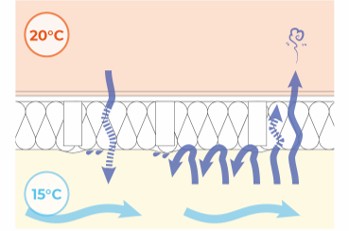
Whether insulating a wall, roof or suspended timber floor, good building physics aims to keep the structure on the warm side of the insulation wherever practical. That’s exactly what Q-Bot’s system does.
Our closed-cell spray foam is applied to the underside of the floorboards, creating a warm floor. The timber remains inside the insulated envelope, staying dry, stable and protected.
In some roof insulation systems, the roof structure remains on the cold side of the insulation. If ventilation is inadequate or ventilation paths are obstructed, condensation can develop. This is one of the key reasons why poorly designed roof insulation systems can lead to moisture concerns, which in turn have contributed to mortgage and surveyor issues reported in recent years.
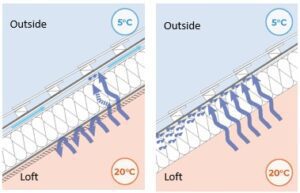
When warm, moist indoor air meets a cooler surface, it reaches the dew point, the temperature where water vapour condenses into liquid. In buildings, this is the point where damp and decay risks begin.
Q-Bot’s underfloor insulation design keeps the timber above the dew point. By applying a continuous, closed-cell layer to the underside of the boards, the dew point is moved below the insulation, into the ventilated void, where any moisture can dissipate naturally.
Independent hygrothermal modelling by Enhabit (2021) and Greengauge Building Energy Consultants (2021) confirmed this. Their analysis found that timber moisture content stabilises between 11–14 %, well below the 18 % threshold for fungal activity, and that relative humidity within the floor void decreases after installation.
This is consistent with the UK Government’s BEIS Guidance on best practice for insulating suspended timber floors, which highlights that maintaining thermal continuity and avoiding cold bridging are key to preventing condensation and mould.
Q-Bot’s approach is validated by three key studies that define best practice for underfloor insulation and moisture control:
Built-In Compliance and Quality Assurance
Every Q-Bot installation follows BEIS Best Practice, PAS 2035 retrofit standards and UK Building Regulations for ventilation, moisture control, and safety.
Each installation includes four layers of quality assurance.
- Pre-install suitability checks – We assess every property for ventilation, service locations, and timber moisture content before installation begins.
- Robotic installation – Our robots apply insulation with precision sensors and live video feedback for even coverage.
- 100% QA audit – Every job is reviewed by our internal Quality Assurance team before certification.
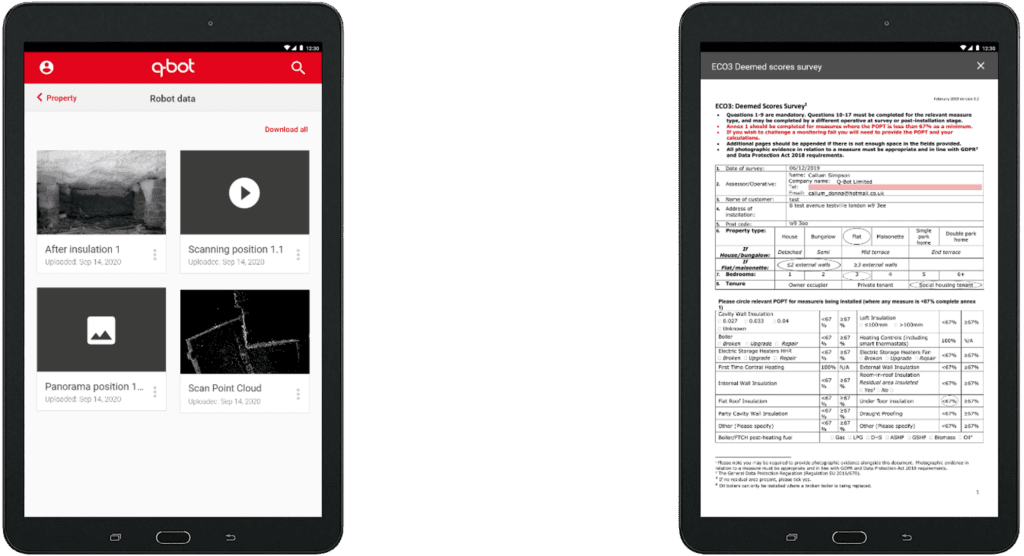
- AI-driven SWARM platform – Our proprietary Install Management System is used to analyse video data, tag potential anomalies, and continuously improve quality across thousands of homes.
Every Q-Bot job is robotically recorded. Footage, images, and data are uploaded to our digital audit trail for permanent reference.
Airbricks and vents are inspected and, if needed, upgraded to maintain proper cross-ventilation — an essential difference from other insulation measures, which often blocks roof airflow.
Every Q-Bot installation leaves a verifiable digital record that homeowners, surveyors, and retrofit coordinators can review at any time.
Across more than 5,500 installations, Q-Bot has not recorded a failure of its insulation system, based on its installation and QA records.
Independent Evidence
Independent studies have shown Q-Bot’s system improves both comfort and building health:
- BEIS (2020) – “Retrofit Floor Insulation: Suspended Timber Floors – Guide to Best Practice”: Establishes how to insulate suspended timber floors safely: emphasising adequate cross-ventilation, avoidance of cold bridges, and the requirement that the structure remains dry and free of condensation in line with Building Regulations Part C.
- Enhabit (2021) – “Q-Bot Hygrothermal Performance Research”: Used WUFI® hygrothermal modelling to show that Q-Bot’s insulation moves the dew point below the foam layer, keeping floorboards and joists warm and dry. Moisture levels remained stable at 11–14 %, and void humidity decreased after installation.
- Greengauge Building Energy Consultants (2021) – “Hygrothermal Risk Analysis Report”: Confirmed Enhabit’s findings across multiple floor types, identifying no interstitial condensation risk even in cold, humid conditions, and verifying full compliance with BS 5250:2021 and PAS 2035.
- NEA (2016–17): Floor-void humidity dropped by up to 30%, indoor humidity by 6%.
- Greengauge (2021): Timber moisture content decreased post-installation.
- Leeds Beckett University (2019): Measured a 24% reduction in total dwelling heat loss.
By creating a “warm floor,” Q-Bot moves the dew point below the timber, keeping the structure dry and healthy.
Q-Bot combines established building science with robotics and AI to deliver consistent installation quality and repeatable outcomes at scale.
Will this affect my mortgage?
Lender and surveyor policies can vary, so if you are buying, selling or remortgaging, we recommend checking with your mortgage broker or lender and explaining that the insulation is installed under the floor, not in the roof.
Mortgage lenders and surveyors may request additional technical information or an independent inspection where underfloor spray foam insulation is present. This does not necessarily indicate a problem with the installation, but reflects individual lender and surveyor requirements.
Q-Bot can provide installation records, product information, warranty details and supporting documentation to help lenders, brokers and surveyors understand the system, including:
- Installation certificate
- Warranty information
- Video QA record
- Pre-install survey
- Moisture readings
- Ventilation checks
- Declaration of Conformity
Every installation is fully documented from pre-install inspection through to final QA, providing homeowners and property professionals with a transparent record of exactly what was installed and how it meets recognised retrofit standards.
The important distinction is that Q-Bot’s underfloor insulation should not be confused with loft spray foam
Q-Bot’s system is installed beneath suspended timber floors, not within roof structures, and follows a different installation method, different moisture management principles and a fully documented quality assurance process.
Every installation is supported by a permanent digital record, giving homeowners, surveyors and lenders clear evidence of what was installed and how it meets recognised retrofit standards.
If you’d like to learn more about how the system works or request technical documentation, our team will be happy to help.